TurboWAM: Learning What Matters for Fast World Action Models

Guile Wu1 Shuangzhi Li1,3,* Xingxin Chen1 Chengjie Huang1 Sam Hosseini1
Tongtong Cao2 Yingxue Zhang1 Dongfeng Bai1
1Huawei Noah's Ark Lab    2Department of Foundation Model, Huawei    3University of Alberta
*Shuangzhi Li contributed to this work during an internship at Huawei Canada.
TurboWAM Illustration

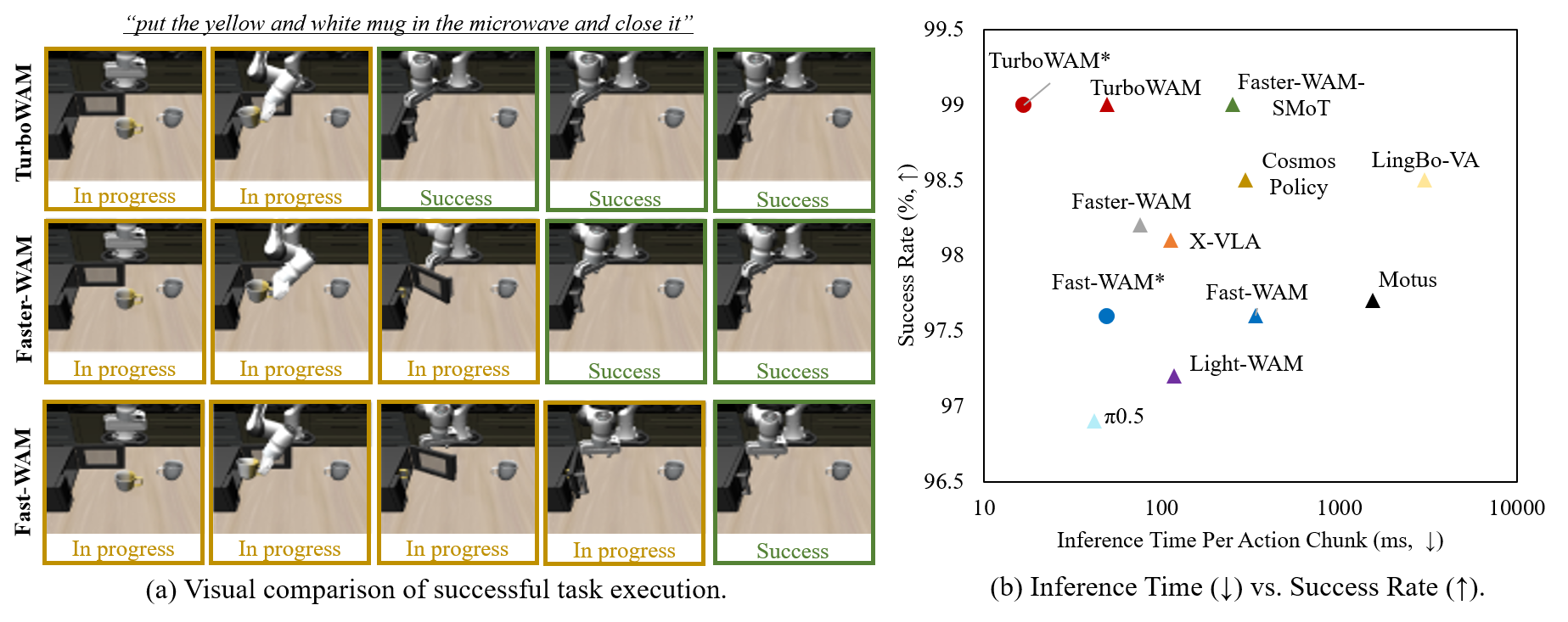
Figure 1. Overview of TurboWAM performance. (a) Visual comparison of successful task execution, highlighting the fast task completion of TurboWAM. (b) Comparison of inference time vs. success rate on LIBERO. TurboWAM achieves a better trade-off between inference time and success rate compared to state-of-the-art methods. TurboWAM* and Fast-WAM* denote versions accelerated using torch.compile with CUDA Graph replay, with compilation and graph capture performed during warm-up before model inference measurement.
Abstract

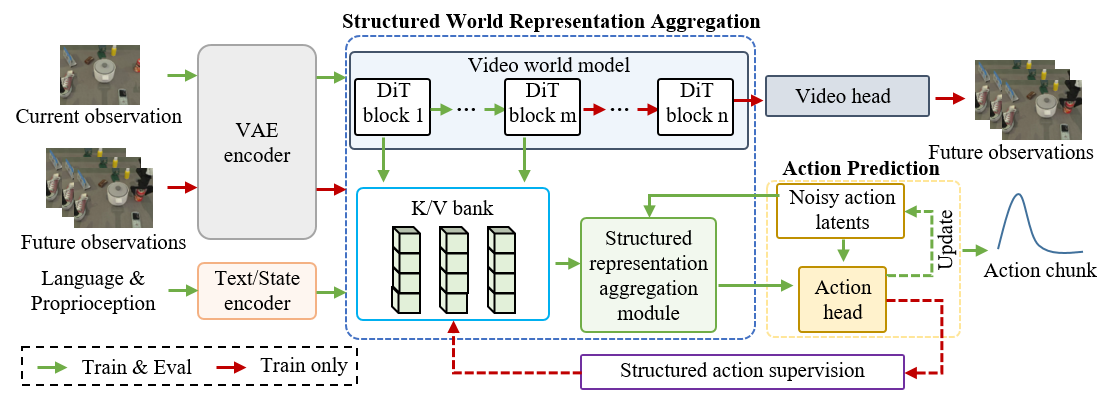
World action models have demonstrated promising performance in robot policy learning, yet their high inference latency remains a critical bottleneck for real-world deployment. Recent approaches have sought to improve inference efficiency by reducing test-time future-frame imagination or accelerating action prediction. However, these methods often leverage representations from all video world model layers without explicitly considering their varying relevance to action prediction, leading to redundant computation and suboptimal representation utilization. In this work, we propose TurboWAM, a fast world action model that efficiently aggregates structured world representations conditioned on action predictions. Specifically, TurboWAM introduces a structured world representation aggregation module that adaptively fuses representations from different world model layers according to their relevance to the evolving action denoising state. Furthermore, TurboWAM employs a structured action supervision mechanism that adaptively modulates gradients from action supervision across different world model layers during backward propagation, facilitating world representation learning. During inference, by reducing the number of world model layers executed and caching relevant representations across action denoising steps, TurboWAM substantially reduces computational overhead. Extensive experiments on multiple robot manipulation benchmarks demonstrate that TurboWAM achieves low inference latency while maintaining competitive task success rates compared with state-of-the-art methods.

Method

TurboWAM Framework

Figure 2. Overview of the TurboWAM framework. The structured world representation aggregation module adaptively fuses representations from different world model layers according to the current action denoising state. The structured action supervision mechanism modulates action-supervision gradients across world model layers during the backward pass. Together, these complementary designs reduce inference latency while maintaining competitive task success rates.

Contributions

Results

Quantitative Results

Quantitative Results Table 1

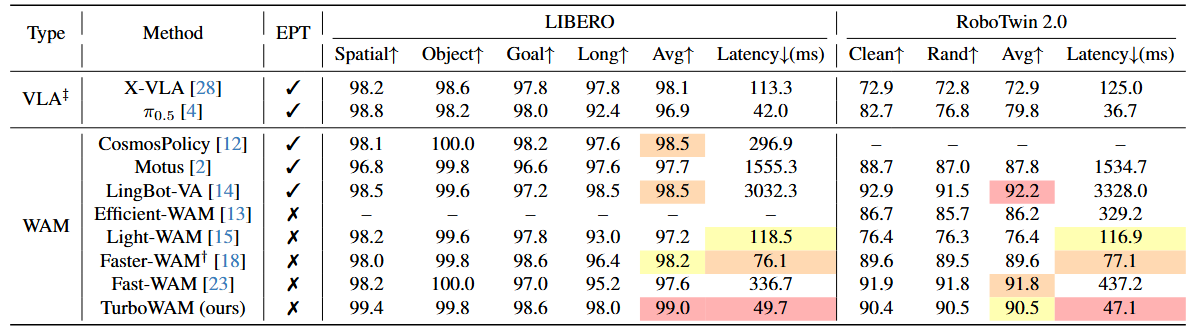
Table 1. Quantitative comparison with state-of-the-art methods on LIBERO and RoboTwin 2.0.

Quantitative Results Table 2

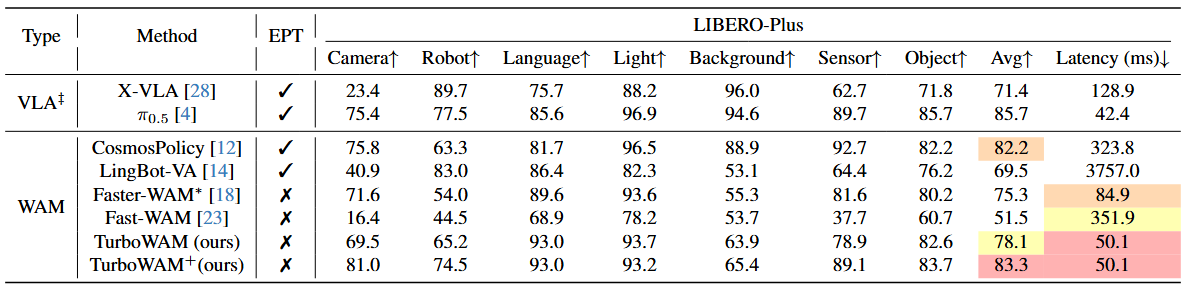
Table 2. Quantitative comparison with state-of-the-art methods on LIBERO-Plus across seven perturbation categories.

Qualitative Results

Qualitative Comparison of Robot Task Execution

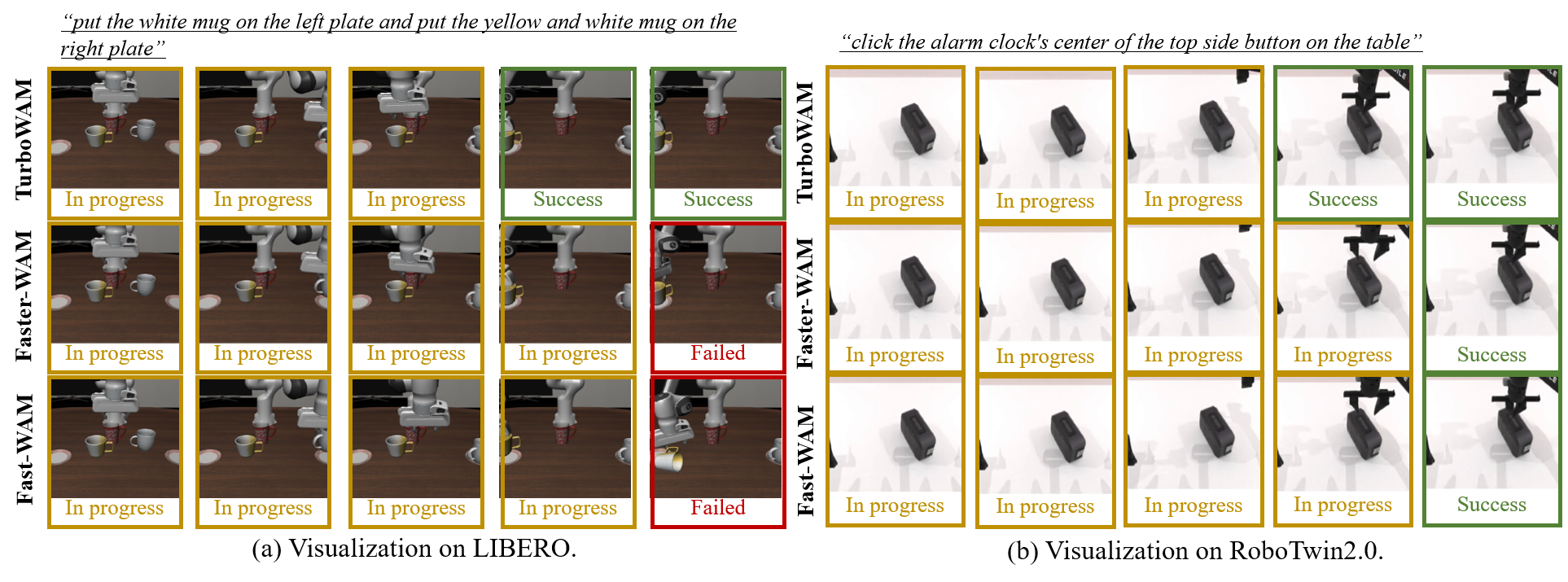
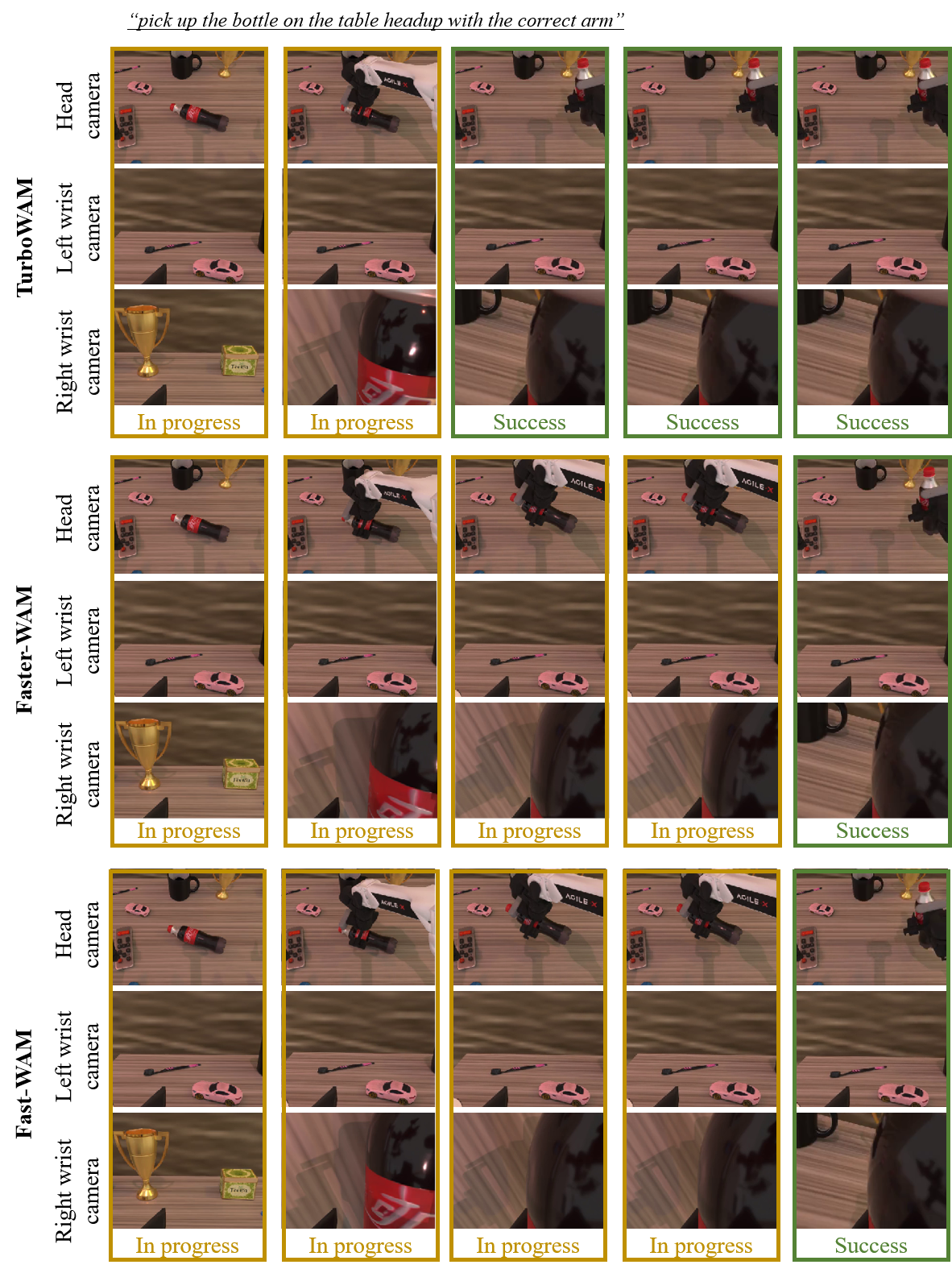
Figure 3. Qualitative comparison of task execution. Each row illustrates the progression of task execution from left to right.

Additional Qualitative Comparisons of Robot Task Execution

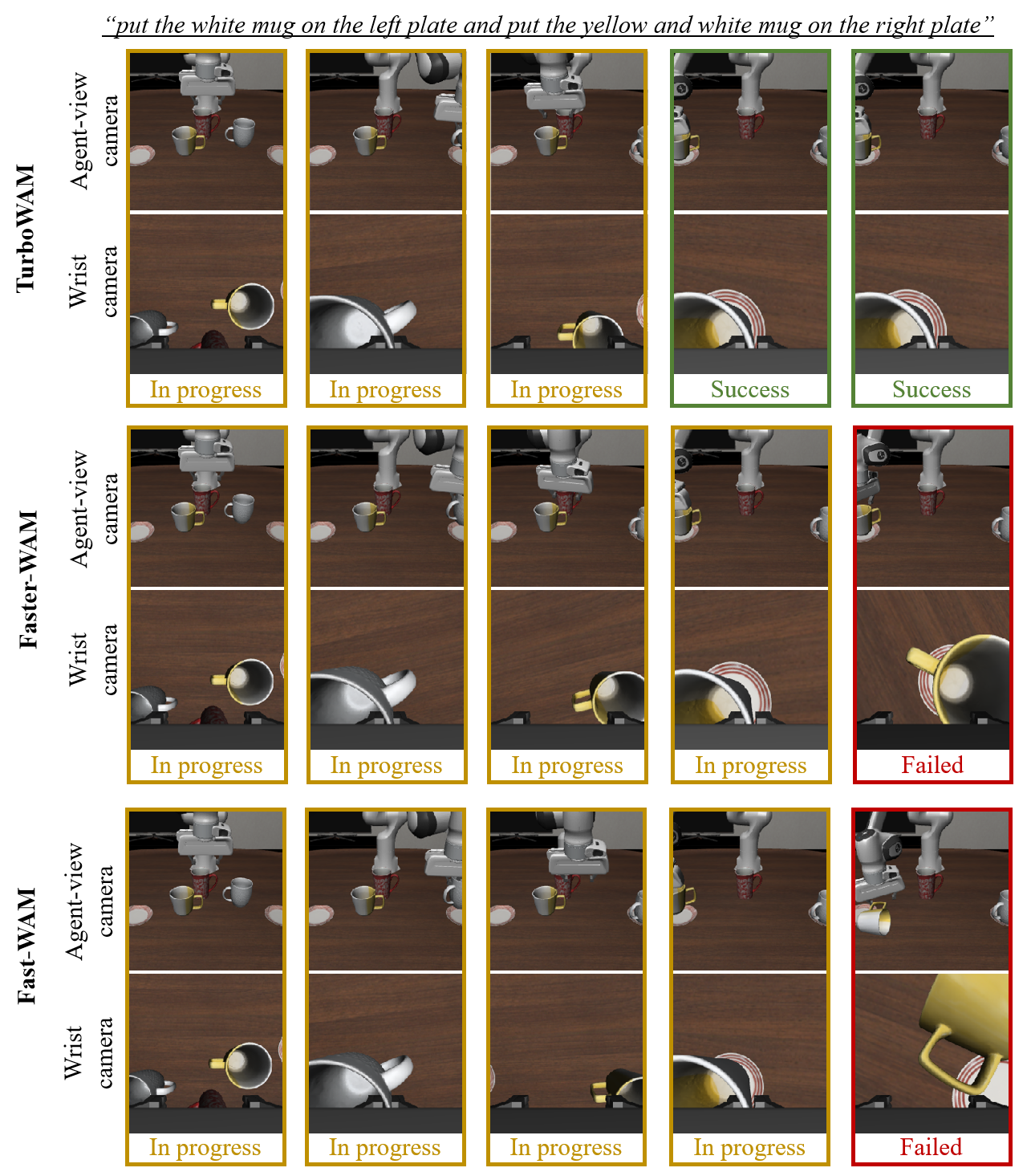
Figure 4. Additional qualitative comparisons of task execution. Each row illustrates the progression of task execution from left to right.

Additional Qualitative Comparisons of Robot Task Execution

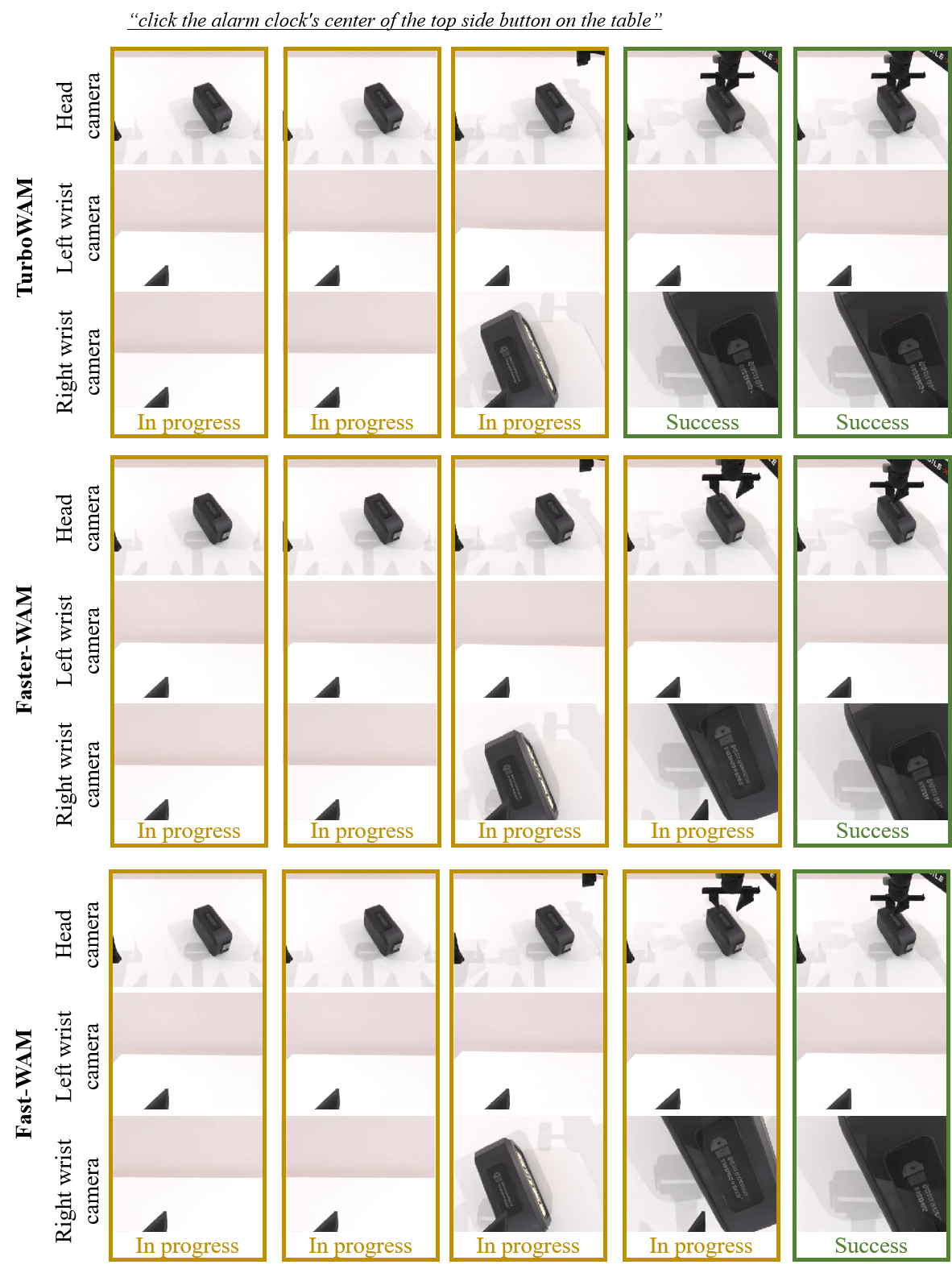
Figure 5. Additional qualitative comparisons of task execution. Each row illustrates the progression of task execution from left to right.

Additional Qualitative Comparisons of Robot Task Execution

Figure 6. Additional qualitative comparisons of task execution. Each row illustrates the progression of task execution from left to right.

BibTeX

If you find this work useful, please cite our paper:

@article{wu2026turbowam, title = {TurboWAM: Learning What Matters for Fast World Action Models}, author = {Wu, Guile and Li, Shuangzhi and Chen, Xingxin and Huang, Chengjie and Hosseini, Sam and Cao, Tongtong and Zhang, Yingxue and Bai, Dongfeng}, journal = {arXiv preprint arXiv:2610.33941}, year = {2026}, }